Guest post
How to Optimize Amazon and Walmart Ad Spend to Protect Profit Margins
TL;DR
Amazon and Walmart advertising can drive growth, but rising sales do not always translate into higher profits. Learn how to evaluate campaign performance, reduce wasted spend, and scale advertising while protecting product-level margins.
Overview
Advertising can help products gain visibility, attract shoppers, and generate sales on Amazon and Walmart Marketplace. But more revenue does not automatically mean more profit. If advertising costs rise faster than the contribution a product earns, a campaign can look successful in the dashboard while putting pressure on the business.
The goal is not simply to lower advertising spend or chase the highest return on ad spend (ROAS). It is to invest in campaigns that contribute to profitable growth. That means understanding each product’s economics, setting realistic advertising targets, identifying wasted spend, and reviewing performance alongside the rest of the business.
Although Amazon Ads and Walmart Connect offer different campaign tools and reporting views, the core discipline is the same: use product-level profitability to guide decisions, then validate those decisions with campaign and sales data.
Why Strong ROAS Does Not Always Mean Strong Profits
ROAS measures attributed sales relative to advertising spend. It is useful for comparing campaign efficiency, but it does not account for the full cost of selling a product.
Marketplace fees, fulfilment, shipping, discounts, returns, product costs, and other variable expenses all affect how much money remains after a sale.
Two products can generate the same attributed sales and report the same ROAS while delivering very different financial results. A product with a higher contribution margin may be able to support more advertising spend, while a lower-margin product may need tighter cost controls.
This is why sellers should avoid applying one advertising target across every product. Campaign performance needs to be evaluated in the context of the product’s costs, margin, competition, and growth objectives.
The Numbers to Review When Optimizing Ad Spend
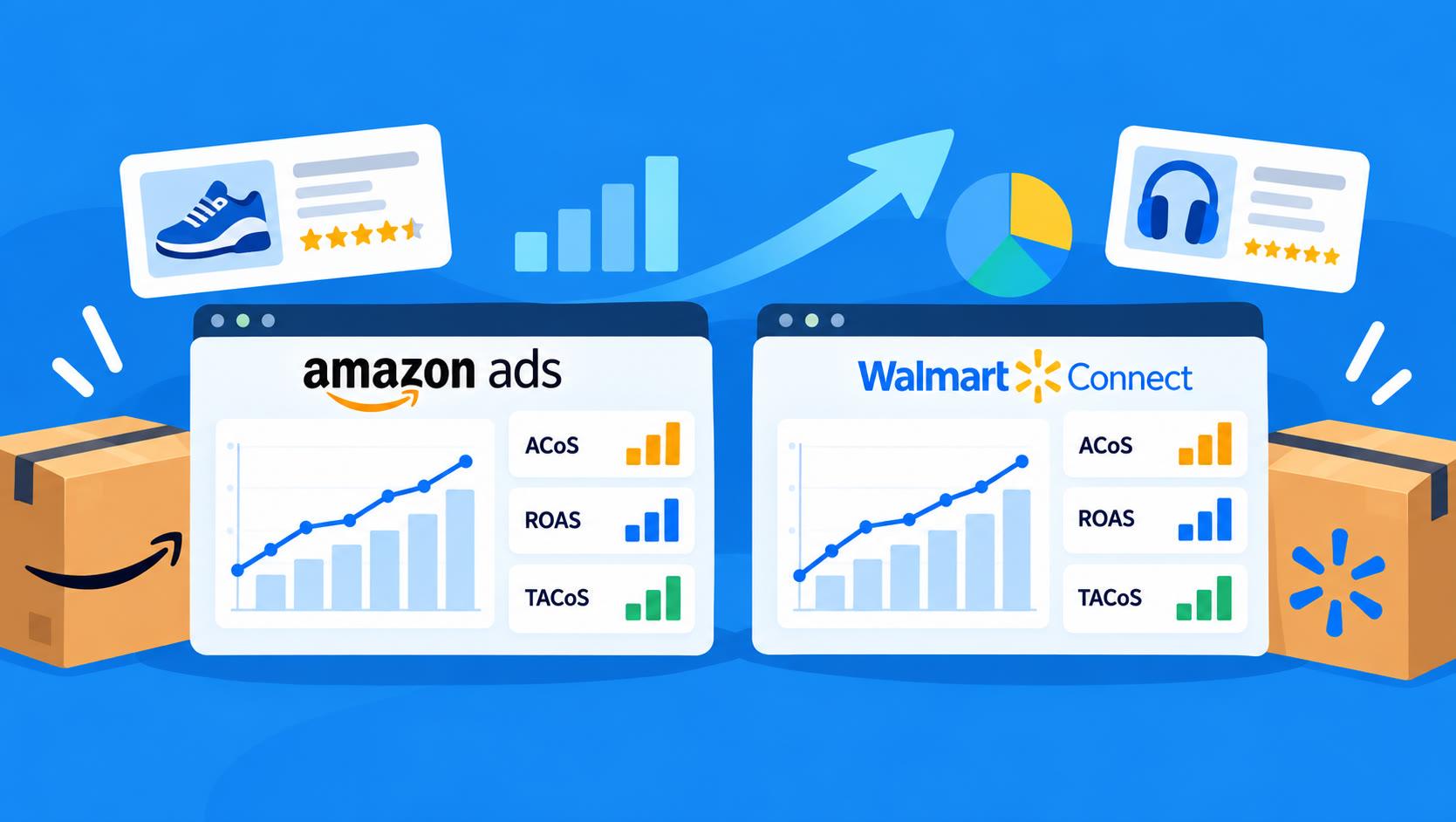
Advertising Cost of Sales (ACoS)
ACoS measures advertising spend as a percentage of attributed advertising sales. It helps sellers understand how much they spend on advertising to generate sales attributed to their campaigns.
A lower ACoS can indicate more efficient advertising, but lower is not always better in every situation. Campaigns designed to introduce a product, build visibility, or explore new audiences may have different objectives from established campaigns focused on profitable sales.
The important question is whether the campaign’s ACoS aligns with the product’s economics and the campaign’s purpose.
Return on Ad Spend (ROAS)
ROAS measures attributed advertising sales relative to advertising spend. It helps sellers compare campaign efficiency and identify advertising activity that generates stronger attributed sales for the money invested.
However, a high ROAS does not automatically mean a campaign is profitable. You still need to consider product costs, marketplace fees, fulfilment expenses, returns, and other costs.
Use ROAS alongside product-level profitability rather than as a standalone measure of success.
Total Advertising Cost of Sales (TACoS)
TACoS compares advertising spend with total sales, including sales not directly attributed to advertising. It can help sellers understand how advertising costs relate to the wider business.
For example, a change in TACoS may be worth investigating alongside organic sales, inventory availability, pricing, promotions, and overall sales performance.
TACoS should not be interpreted in isolation. A change in the metric does not, by itself, prove that advertising caused a change in organic performance.
Conversion Rate and Cost Per Click
Conversion rate helps sellers understand whether shoppers who click on an ad go on to purchase. Cost per click indicates how much they pay to attract that traffic.
If clicks get more expensive while conversion remains weak, higher bids may not fix the problem. Review targeting, listing quality, pricing, reviews, availability, and whether the product matches the shopper’s intent.
Improving the quality of traffic and the shopping experience can be just as important as adjusting bids.
Product Contribution Margin
Contribution margin helps sellers understand what remains from sales after the variable costs included in their calculation.
For advertising decisions, establish a consistent product-level view that accounts for relevant costs, such as product cost, marketplace fees, fulfilment, shipping, discounts, and returns.
The exact calculation should reflect the business’s accounting approach. Once product economics are understood, sellers can make more informed decisions about how much advertising a product can support.
Where Advertising Budgets Are Commonly Lost
Irrelevant Search Terms and Placements
Broad or automatic targeting can uncover valuable opportunities, but it can also spend money on searches or placements that do not match the product or attract likely buyers.
Review search-term and targeting reports regularly. Identify irrelevant queries, assess which terms generate meaningful results, and use negative targeting where appropriate.
Keep discovery activity distinguishable from proven performers so you can evaluate each campaign according to its purpose.
Listings That Do Not Convert
More traffic will not fix a weak product detail page.
Review the main image, title, bullet points, product information, pricing, availability, reviews, and delivery promise. The listing should clearly communicate what the product offers and help shoppers make an informed purchasing decision.
If a product receives clicks but struggles to convert, investigate the reasons before committing more budget to generating additional traffic.
Bids That Ignore Product Economics
A bid that makes sense for a high-margin product may be too aggressive for a low-margin one.
Set advertising targets with the product’s profitability and competitive position in mind. Also consider whether a campaign is intended to generate immediate sales, launch a product, or support longer-term growth.
The right decision depends on the objective, but spending should always be evaluated against a clear business rationale.
Budgets That Never Change
Leaving every campaign on the same budget can limit opportunities for strong performers while allowing inefficient campaigns to continue spending.
Review budget allocation using reliable performance data, inventory availability, seasonality, and product-level profitability. Reallocate spend when the evidence supports a change, rather than automatically increasing every campaign’s budget as sales grow.
A Practical Process for Optimizing Amazon and Walmart Campaigns
1. Establish a Product-Level Profitability Baseline
Before making significant advertising changes, understand the economics of the products being promoted.
Review selling price, product costs, marketplace fees, fulfilment and shipping expenses, expected returns, discounts, and other relevant variable costs.
Group products by margin, price point, sales performance, or strategic role. This makes it easier to distinguish products that can support more advertising investment from those that require tighter controls.
2. Separate Campaigns by Objective
Not every campaign serves the same purpose.
Discovery campaigns help identify new search terms and opportunities. Established campaigns may focus on converting proven demand, while branded campaigns or product-launch campaigns may serve different strategic goals.
Where platform options allow, structure campaigns so their objectives and results can be evaluated separately. This helps prevent a single performance target from being applied to every campaign.
3. Review Search Terms, Keywords, and Item Performance
Use the reporting tools available on each marketplace to understand where advertising spend goes and which activities generate meaningful results.
On Amazon, review available search-term, targeting, and placement reports to identify relevant queries, strong performers, and potential sources of wasted spend.
On Walmart, use available campaign and item-level reporting to assess advertising spend, attributed sales, ROAS, conversion, and other relevant metrics.
Reporting options can vary by campaign type and account. Focus on the information available to you and use consistent evaluation criteria wherever possible.
4. Reallocate Spend Instead of Cutting Everything
Reducing advertising spend across the board may limit both waste and valuable sales opportunities.
Instead, identify campaigns and targeting opportunities that consistently underperform against their objectives. Consider reducing bids, limiting budgets, refining targeting, or excluding irrelevant searches where appropriate.
At the same time, look for campaigns that merit additional investment. Make budget changes gradually enough to evaluate their effects, and avoid drawing strong conclusions from a small amount of data.
5. Measure the Wider Business Impact
Advertising dashboards provide important information, but they do not tell the whole business story.
Compare attributed advertising results with total sales, organic performance, inventory availability, pricing, promotions, and product-level profitability.
A campaign may influence sales beyond what the advertising platform attributes, but that effect should be assessed carefully rather than assumed. Changes in sales can also result from seasonality, promotions, stock levels, competition, or other factors.
Looking at the wider picture helps sellers make decisions based on business performance rather than advertising metrics alone.
6. Create a Repeatable Review Routine
Advertising optimization should be an ongoing process rather than an occasional reaction to poor results.
Check campaign pacing and urgent issues regularly. Review search-term and campaign performance on a consistent weekly schedule, then conduct a broader monthly assessment of product profitability, TACoS, organic sales, inventory, and budget allocation.
During product launches, major promotions, or seasonal peaks, closer monitoring may be appropriate. The goal is to establish a routine that allows you to spot problems, test improvements, and make informed decisions without changing campaigns unnecessarily.
Common Mistakes to Avoid
- Using one ACoS or ROAS target for every product. Different products have different costs, margins, competitive pressures, and strategic objectives.
- Treating attributed sales as if they were all incremental sales. Attribution helps evaluate campaigns, but it does not automatically prove that every attributed purchase would not otherwise have happened.
- Increasing bids before checking listing quality. Poor conversion may be related to pricing, product content, availability, or shopper expectations rather than insufficient traffic.
- Pausing campaigns before enough data is available. Low-volume campaigns can fluctuate, so consider sample size, campaign objectives, and performance trends before making significant changes.
- Ignoring variable costs. Advertising performance should be evaluated alongside the costs that affect product profitability.
- Applying identical execution across Amazon and Walmart. The same financial discipline can guide both marketplaces, but campaign structures, reporting options, and optimization decisions should reflect each platform’s capabilities.
Frequently Asked Questions
What Is a Good ROAS for Amazon or Walmart Ads?
There is no universal ROAS target that works for every seller or product. The appropriate target depends on product contribution margin, selling costs, competition, campaign objectives, and the business’s growth priorities.
Start by understanding product economics, then evaluate whether campaign performance supports the intended business outcome.
Should I Pause a Campaign With High ACoS?
Not automatically. Review the campaign’s objective, performance trend, search terms, conversion rate, product margin, and available data.
A campaign with high ACoS may need tighter targeting or lower bids. In other situations, it may be supporting a launch or another strategic objective. Decisions should reflect the campaign’s purpose and the evidence available.
How Often Should I Optimize Campaigns?
Check campaign pacing and urgent issues regularly, and assess performance on a consistent weekly schedule. Use a broader monthly review to connect advertising performance with product margins and total business results.
New campaigns and major promotional periods may require closer attention.
Why Track TACoS as Well as ROAS?
ROAS focuses on sales attributed to advertising, while TACoS compares advertising spend with total sales.
Looking at both can provide a broader understanding of advertising performance. Neither metric replaces product-level profitability analysis or explains business performance on its own.
Can I Use the Same Strategy on Amazon and Walmart?
The same principles of cost control, measurement, and margin awareness can guide advertising on both marketplaces. However, campaign execution should reflect each platform’s advertising options, reporting capabilities, shopper behavior, and available data.
Evaluate each marketplace on its own terms before comparing performance or moving budgets between them.
The Bottom Line
Protecting profit margins does not mean avoiding advertising. It means understanding what each product can afford to spend, using marketplace reports to identify the strongest opportunities, and judging campaigns by their contribution to the business rather than sales alone.
Want this kind of clarity for your Amazon business?
Book a demo and we will connect your Amazon accounts with you, so you can see it on your own data.
Book a demo